How to price pressure washing jobs
Build a price from the surfaces you’ll clean and the time the whole visit takes. See a worked house-wash estimate and what changes the final charge.

Published
Before you start
- Count travel, setup and cleanup as well as the time spent washing.
- A house’s floor area does not tell you how much exterior surface needs cleaning.
- Cover your job costs and overhead before adding profit to the price.
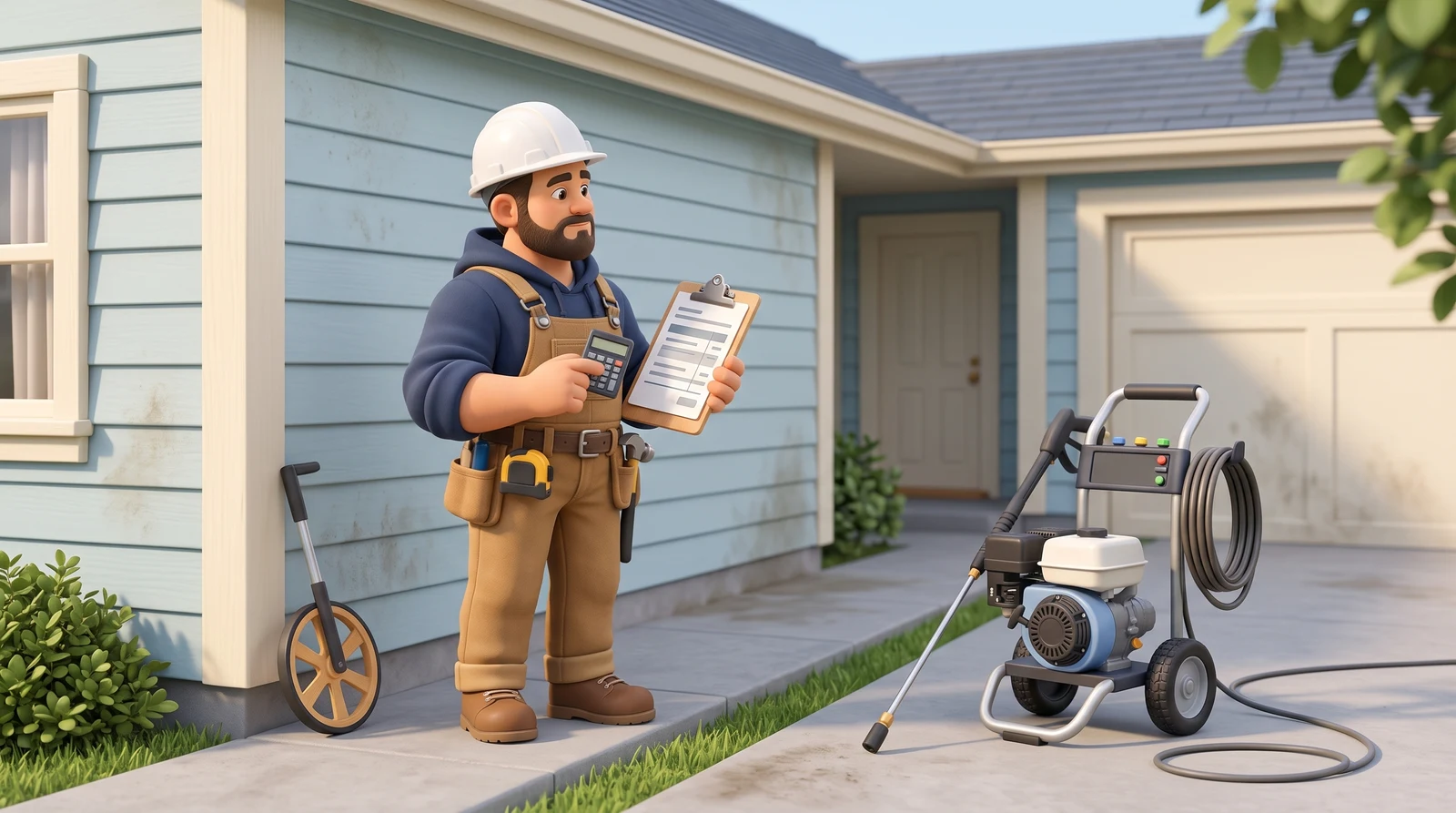
To price a pressure washing job, define the scope, add up every person-hour for the visit, and add each cost once. Then add profit and compare the result with similar jobs you've finished. Your price needs to cover the whole job, including the time before and after you turn the machine on.
Price before tax = labor + supplies + equipment and travel + allocated overhead + profit.
For a house described as 2,000 sq ft, start by checking what actually needs washing. Floor area alone won't tell you the work involved. The example below comes to $375 before tax, using sample USD costs and a defined scope. It shows the calculation, not a going rate for every house that size.
Square-foot, hourly or fixed-job pricing: which fits your visit
Square-foot pricing works only when you've defined the area, the surface and what's included. A rate with no scope behind it can't be compared from one job to the next.
Hourly pricing fits work where you can't see the scope up front. Allow for travel, setup and cleanup when you build your charge-out rate. Agree which time is billable, any callout charge and how you'll handle extra work before starting. What an hour of labor costs you is different from what you charge your customer.
A fixed job price gives your customer one total for an agreed scope. Build it from your time and costs, then check it against past jobs.
A practical way to use all three is to build the fixed price from costs first. Then divide it by the measured area as a sanity check against jobs you've already done.
How much should you charge to wash a 2,000 sq ft house?
For the house in the worked example below, the price is $375 before tax. That figure comes from stated assumptions, not a market average. Different siding, access or scope would change it.
Floor area describes the inside of the home. The wash area is the wall surface, and that depends on footprint shape, perimeter, number of stories, wall height, gables and openings. Two houses with 2,000 sq ft of floor area can have very different wall areas.
Here's the measurement for a rectangular one-story house with a 50 ft by 40 ft footprint:
- Perimeter: 50 + 40 + 50 + 40 = 180 ft
- Gross wall area at 9 ft wall height: 180 × 9 = 1,620 sq ft, before openings and gables
This number only shows how to measure. No per-square-foot price is applied in the example. Windows and doors may need protection even when you don't wash them, so they can add time without adding washable area.
Before settling on the price, check what will change your time or costs:
- Surface and condition. Separate an ordinary wash from stain treatment, stripping or restoration.
- Access and height. Note tight side paths, obstacles, hose runs and any access equipment the job needs.
- Water and runoff. Confirm the available water supply and the arrangements for handling wash water. Price any extra equipment or handling time.
- Protection and scope. Agree who moves furniture and what needs protecting. List driveways, roofs and gutter interiors separately if requested.
Siding matters because it limits your method. James Hardie's cleaning guidance advises against a high-pressure power washer on its siding and describes a low-pressure hose with a soft nonmetal brush. That's guidance for one product, not a rule for all siding. It does show that the method a surface allows changes the work you're pricing.
Multiplying 2,000 by a wall-washing rate would use the wrong measurement. Experienced operators can still build floor-area packages for similar houses from their own job history. That works because the rate comes from completed jobs with known time, costs and scope, not from the floor area alone.
Worked example: pricing a house wash from your costs
These are sample prices in USD before applicable tax. Replace the time and costs with your own.
Scope: One-story house the owner describes as 2,000 sq ft of floor area. You wash the accessible exterior siding using the method that siding allows. The dirt is ordinary surface dirt, ground access is clear and the customer's water supply is usable. The job excludes the roof, driveway, gutter interiors, window detailing and specialist stain removal. Confirm protection and runoff arrangements before you use the allowances below.
Time for the whole visit
| Task | Person-hours |
|---|---|
| Travel | 0.5 |
| Setup and protection | 0.75 |
| Washing and rinsing | 2.75 |
| Cleanup and packing | 0.5 |
| Job-specific quoting and admin | 0.5 |
| Total | 5 |
Five hours is this sample's assumption, not a production rate. Count one worker's total time, and count your own time if you do the work. Owner labor isn't free. Your labor cost estimate should come from your own figures.
Job costs
| Cost | USD |
|---|---|
| Labor: 5 hours × $32 | 160 |
| Cleaning supplies | 25 |
| Equipment use and wear | 35 |
| Vehicle travel cost | 20 |
| Allocated business overhead | 60 |
| Total cost | 300 |
The $32 is a cost allowance that includes relevant employment costs. It isn't the hourly rate you charge your customer. Each line stays separate so nothing is counted twice:
- Vehicle cost leaves out wages already counted in labor.
- Equipment cost leaves out the vehicle.
- Overhead leaves out the direct costs above and the admin time already in the labor hours.
From cost to price
- Profit allowance: $300 × 25% = $75
- Price before tax: $300 + $75 = $375
Overhead is already inside the $300, so the 25% is profit, not a second overhead charge. The 25% is also a markup, which is a percentage added on top of your cost. It isn't the same as margin, which is profit as a share of the price. Here, $75 ÷ $375 = 20% margin. The 25% is an illustration, not a trade standard. To test other numbers, try the contractor markup calculator.
What one extra hour does
One more person-hour at $32 lifts your cost to $332. At the same 25% markup, the price becomes $415. That's $40 more, not $32, because the markup applies to the added cost too. If you add chemical or equipment costs, add them separately.
Set a minimum visit charge from your own costs
A minimum exists because travel, setup, protection, cleanup and admin happen even when the surface is small. In the sample, 2.25 of the 5 person-hours (0.5 + 0.75 + 0.5 + 0.5) go to those tasks instead of washing. That's this sample's arithmetic, not a typical split.
To set your own floor, run the same cost build for a very small job with little washing time. Add your profit and use the result as the minimum. Don't borrow a national figure. Your travel distance, setup routine and overhead decide where the floor sits.
Check the runoff arrangements before quoting. If the job needs collection equipment, extra handling time or disposal, include those costs in the visit.
PWNA's Know Your Numbers training covers job costing and overhead allocation for exterior-cleaning businesses if you need help building those figures.
Check your number against jobs you've already done
After the job, compare the hours and costs you allowed with what you actually spent. For repeat work, divide the selling price by the measured cleaning area to get a useful comparison rate. Keep driveway rates separate from house-wash rates. If you use floor-area packages for houses, compare only properties with similar stories, siding, access and scope.
If it's far from your history, look for a cause before you change the price. Common causes are missing time, a scope difference or a cost you didn't count. If you haven't completed comparable jobs yet, build the first quotes from a site assessment and realistic time allowances. Record the results so each estimate has better information behind it.
Roof cleaning, stripping, sealing and specialist stain removal are separate scopes. Price each on its own instead of assuming it's inside a house wash. Local rates and customer expectations vary, so judge the result against your own costs and market.
Make the scope clear on the estimate
Give your customer a description they can check against the property: which surfaces you'll wash, what's included in preparation, and which extras are excluded. Show optional work separately, such as a driveway clean alongside the house wash.
State the water-supply assumption, access needed, price and any applicable tax. If specialist stain treatment needs a separate assessment, say so before the customer accepts the estimate. That gives you both a clear starting point if they ask for more work.
For a document you can fill in now, use the free pressure washing estimate template. It includes a blank PDF, Excel workbook and completed example matching the $375 house wash above.
If you'd rather not rebuild the time, cost and scope lines by hand for every visit, Construction Job Estimator can turn the job into a professional estimate or quote in minutes. Describe the work by voice or text, add site photos, and review the working estimate it builds. Labor, materials and other job costs sit in the same estimate. You can see the quantities, prices and labor behind each figure and adjust them before anything goes to your customer. When they accept, you can convert the estimate into an invoice. The pressure washing estimating app page shows how that fits this trade. You still decide the scope, method, time and allowances, and the app gives you one place to check and change them.